Why Appliance Garages Are Making a Comeback for Clutter-Free Kitchens
Homeowners seek clean countertops without sacrificing access to essential tools. Appliance garages address this need by providing concealed storage that integrates into kitchen designs. These features restore order to busy spaces, combining utility with visual appeal.
The Evolution of Appliance Garages
Appliance garages gained prominence in the mid-20th century alongside the rise of household appliances. As open shelving and minimalist aesthetics dominated later decades, these storage units faded from view. Today, they reemerge to meet demands for organized, serene environments.
Contemporary versions extend beyond basic enclosures. They incorporate roll-up doors, integrated outlets, and customizable interiors to accommodate devices like blenders and coffee makers. This evolution ensures compatibility with diverse kitchen layouts, from compact apartments to expansive homes.
Key Reasons for Their Resurgence
Current design trends emphasize calm and efficiency in kitchens. Appliance garages support these goals by hiding appliances without hindering use. They prevent counters from resembling gadget displays, fostering a more inviting atmosphere.
Three primary factors drive their popularity:
- Enhanced Visual Appeal: Concealed storage expands perceived space and highlights architectural elements like backsplashes.
- Improved Organization: Dedicated compartments simplify appliance handling and cord management.
- Versatile Integration: Options range from tambour doors to lift-up panels, suiting various aesthetics and budgets.
Design professionals note that cleared surfaces immediately elevate a room's sophistication, a principle applicable to both residential and staged settings.
Budget-Friendly Implementation Options
Appliance garages accommodate different financial levels, ensuring accessibility for all.
For budget-conscious projects, repurpose a stock cabinet from a hardware store. Install a sliding panel or tambour door, then finish with paint to match existing cabinetry. This approach costs under $100 with basic tools.
Mid-range solutions involve custom modifications during partial remodels. A carpenter can add a pocket door or lift-up mechanism, priced between $250 and $600 based on materials. Such additions enhance cabinetry without extensive changes.
Luxury installations feature tailored units with internal lighting, outlets, and adjustable shelving. These bespoke designs justify higher costs through superior functionality and seamless aesthetics.
Strategic Placement Considerations
Effective placement aligns with daily workflows. Evaluate traffic patterns and appliance frequency to optimize access.
Corner units utilize underutilized spaces at countertop intersections, preserving flow. Under-cabinet models position storage directly below uppers, ideal for smaller appliances.
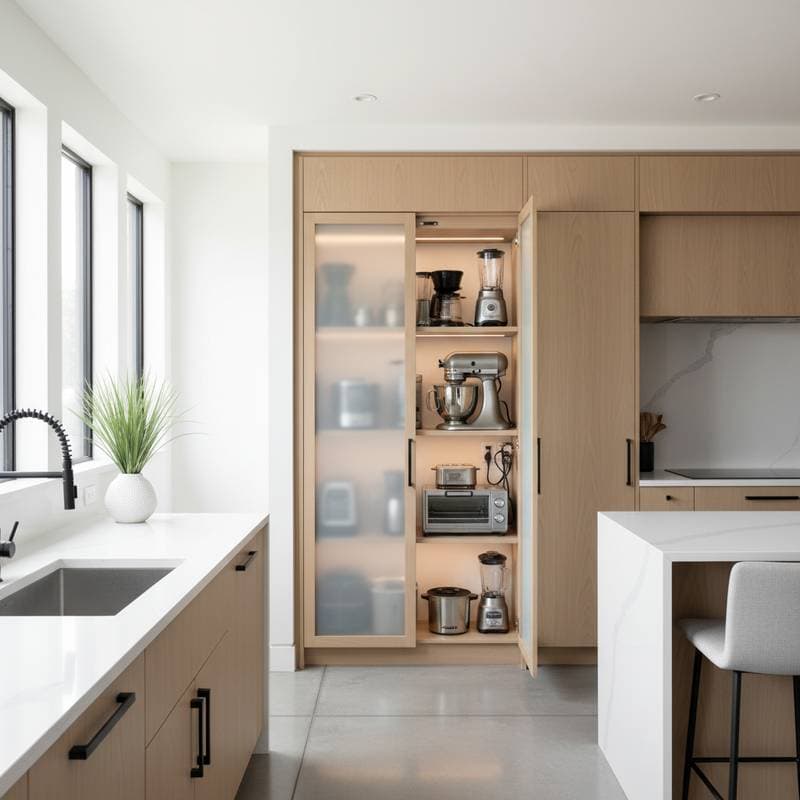
Pantry integrations dedicate shelving within cabinets, incorporating outlets for convenience. Counter-depth options mimic cabinetry, blending into surfaces when closed.
Professionals recommend viewing kitchens from multiple angles to ensure smooth lines and hidden elements contribute to overall harmony.
Styling Appliance Garages
These storage features offer opportunities for personalization. Select finishes that complement the kitchen's theme.
Matching cabinet tones maintains cohesion. Contrasting materials, such as wood against neutrals, introduce subtle interest.
Modern interpretations favor flat panels with touch-latch openings. Glass accents, like frosted panels, allow glimpses of contents while preserving concealment.
Integration ensures the garage enhances rather than disrupts the design narrative.
Functional Enhancements
Beyond storage, appliance garages improve usability. Incorporate elements that streamline operations.
Built-in outlets eliminate relocation needs. Pull-out trays support heavier items, facilitating easy retrieval.
LED under-cabinet lighting illuminates interiors upon opening. Cord organizers prevent tangles and maintain tidiness.
These details create efficient systems, reducing daily friction in kitchen tasks.
Non-Invasive Installation Methods
Achieve benefits without full renovations through adaptive strategies.
Modify existing cabinets by removing shelves and adding hinged doors. This yields immediate concealed space.
Construct a countertop enclosure with a matching lid, suitable for temporary setups. Portable carts with covers provide mobility for renters.
Pantry retrofits allocate sections for appliances, using extension cords where necessary.
Such methods deliver results efficiently and economically.
Insights from Design Practice
Professional transformations reveal the impact of organized surfaces. Cleared counters amplify lighting and focal points, creating polished environments.
Appliance garages replicate this effect in homes, promoting a sense of order. Clients often report heightened satisfaction from these simple upgrades.
For designers, incorporating garages adds practical value to projects. Homeowners benefit from sustained usability and aesthetic refinement.
Opportunities in Product Development
Innovations in hardware and modular systems expand possibilities. Enhanced lift mechanisms and durable finishes improve longevity.
Builders can leverage these features to differentiate custom work. The trend underscores a shift toward multifunctional spaces.
Maintenance for Longevity
Sustain performance with routine care. Clean interiors weekly to remove residues.
Inspect mechanisms regularly for smooth operation. Organize cords to avoid interference.
Install soft-close features to protect components.
Realizing the Benefits
Implementing an appliance garage transforms kitchen dynamics. It encourages habitual organization and elevates daily experiences.
Homeowners gain enduring value from spaces that feel intentional and serene. This investment supports both functionality and enjoyment.