Why Curved Kitchens Surpass the Traditional Work Triangle
Imagine entering your kitchen with a morning beverage in hand, only to navigate a series of sharp turns between the sink, stove, and refrigerator. The traditional work triangle layout served its purpose in compact spaces dedicated solely to meal preparation. However, as kitchens evolve into multifunctional hubs for entertaining, studying, and dining, this rigid configuration often feels confining and obsolete.
Curved kitchen designs address these limitations by introducing fluid lines that enhance circulation and comfort. These layouts soften transitions, expand usable space, and foster a more intuitive environment. The following sections explore the advantages of curved kitchens and practical steps for implementation.
Understanding the Traditional Work Triangle
The work triangle concept aims to optimize efficiency by positioning the sink, stove, and refrigerator at the vertices of an imaginary triangle. This arrangement reduces unnecessary steps during cooking tasks. Yet, contemporary kitchens frequently incorporate additional elements such as prep islands, beverage stations, and integrated seating, which disrupt this linear model.
Curved layouts adapt seamlessly to these expansions. They promote continuous pathways that align with natural human motion, transforming routine activities into effortless processes. This shift not only streamlines operations but also elevates the overall user experience.
Limitations of Linear Configurations
Straight counters and right-angle corners frequently cause congestion, particularly when multiple individuals occupy the space. Such designs lead to awkward reaches and physical collisions. Curved elements mitigate these issues by opening pathways, minimizing obstructions, and facilitating smoother navigation.
Even modest curvatures can alleviate the tunnel-like feel of narrow galley kitchens. By eliminating harsh angles, these designs reduce visual rigidity and promote a more spacious perception.
Benefits of Curved Dynamics
Curved configurations facilitate rotational movement over repetitive linear paths. This approach mirrors instinctive body mechanics, enhancing comfort during extended use. Additionally, rounded forms improve visibility and diminish hazards from protruding edges, proving especially valuable in homes with young children or frequent visitors.
Implementing Curved Kitchen Layouts
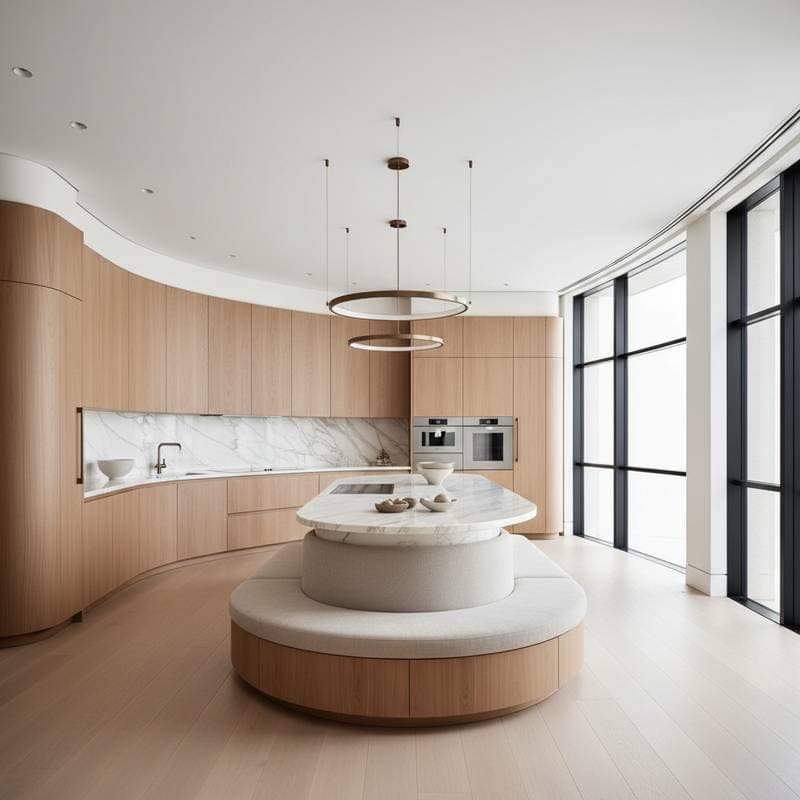
Curved kitchens incorporate arcs in select features rather than requiring fully rounded surfaces. Common applications include islands, cabinet fronts, countertop perimeters, and ceiling elements. The objective remains consistent: to eliminate abrupt interruptions and cultivate seamless progression.
Popular Curved Configuration Types
-
Central Curved Island
A rounded island serves as the primary hub, accommodating ample seating and multidirectional access. This style integrates effectively within expansive, open floor plans, encouraging interaction from various angles. -
Undulating Countertops
Counters that gently wave along their length define distinct zones without imposing barriers. Such forms prove adaptable to asymmetrical room shapes, preventing inefficient space utilization. -
Complete Circular Arrangements
In compact residences or studios, a full circle positions all essentials within arm's reach. This efficient setup suits solo users seeking optimal functionality in limited areas. -
Arced Wall Installations
Curved cabinet sequences along walls invigorate elongated spaces, imparting a sense of breadth and equilibrium to otherwise linear designs.
These variations scale according to available dimensions and financial parameters.
Key Functional Benefits
Enhanced Ergonomics
Curved surfaces align with organic body postures, minimizing stress on joints and muscles. Users rotate fluidly instead of executing abrupt pivots, which proves beneficial during prolonged sessions. Furthermore, rounded edges simplify maintenance by preventing residue accumulation in crevices, thereby supporting superior sanitation.
Improved Safety and Inclusivity
Protruding corners contribute to common injuries in active kitchens. Curved alternatives lessen these dangers, offering particular advantages for households with mobility limitations or elderly members. The unobstructed flow aids wheelchair navigation and broadens access to preparation areas.
Aesthetic Harmony and Continuity
Organic lines guide visual interest throughout the space, imparting a serene, dynamic quality absent in angular setups. In integrated living environments, curves facilitate cohesive transitions between functional zones. The kitchen thus integrates as an extension of communal areas rather than an isolated utility.
Efficient Space Utilization
In confined settings, curvatures expand perceived volume by reclaiming corner dead zones. Larger kitchens benefit from zonal delineation via subtle arcs, maintaining connectivity without physical dividers. This versatility supports diverse activities in unified yet segmented layouts.
Essential Planning Factors
Curved designs demand meticulous execution to balance aesthetics and utility. Homeowners should evaluate several components prior to proceeding.
Investment Overview
-
Basic Curved Accents:
Incorporating a rounded laminate edge or peninsula costs between $500 and $1,200. This option allows experimentation with minimal disruption. -
Moderate Customizations:
Semi-curved islands or cabinets range from $8,000 to $15,000, encompassing materials like quartz that conform to specified radii. -
Premium Comprehensive Projects:
Full integrations with bespoke elements exceed $25,000, often featuring advanced techniques and high-grade surfaces such as veneered hardwoods.
Suitable Material Options
-
Thermoformable Surfaces:
Products like Corian enable seamless shaping for counters and integrated features. -
Flexible Base Structures:
Plywood or medium-density fiberboard forms the foundation for curved cabinets, finished with durable laminates or paints. -
Reflective Inserts:
Bent glass or acrylic enhances illumination in cabinetry or splash areas.
Dimensional and Layout Strategies
Precise calculations ensure compatibility with fixtures. Engage professionals versed in curved metrics to align components accurately. Opt for shallow radii in small areas to preserve openness.
Allocate 36 to 42 inches of walkway around islands for adequate clearance. In constrained layouts, a single-sided curved peninsula delivers comparable advantages with reduced spatial demands.
Regulatory and Installation Standards
Curved elements adhere to existing building codes, though adjustments may influence outlet placements or airflow. Consult certified specialists for any relocations involving utilities.
Specialized hardware secures curved doors and drawers; professional installation prevents operational flaws.
Project Duration
Fabrication extends timelines by 2 to 4 weeks due to custom shaping. Verify supplier schedules early to align with overall renovation phases.
Strategies for Effective Curved Designs
-
Map Current Movements:
Diagram existing patterns to pinpoint opportunities for ergonomic enhancements via curves. -
Integrate Linear Elements:
Combine arcs with straight segments to achieve stability and prevent overwhelming fluidity. -
Align Illumination:
Position fixtures to trace curved contours, ensuring uniform lighting and accentuating forms. -
Optimize Storage Solutions:
Compensate for potential volume reductions with specialized organizers in proximate straight sections. -
Synchronize Adjacent Features:
Coordinate floor patterns and overhead elements to complement rather than contrast the curves. -
Plan for Upkeep:
Source compatible cleaning aids and retain spare components for sustained appearance.
The Intuitive Appeal of Curved Spaces
Curved kitchens extend beyond practicality to evoke a profound sense of ease. Organic forms align with innate preferences for softness, fostering tranquility amid daily routines. In versatile environments, these designs cultivate lingering social interactions and familial cohesion.
Steps to Adopt Curved Elements
Begin with incremental changes, such as a contoured seating nook, to assess impacts on usability. Collaborate with skilled fabricators for prototypes or visualizations. As lifestyles prioritize fluidity, curved kitchens deliver enduring efficiency and warmth tailored to modern needs.