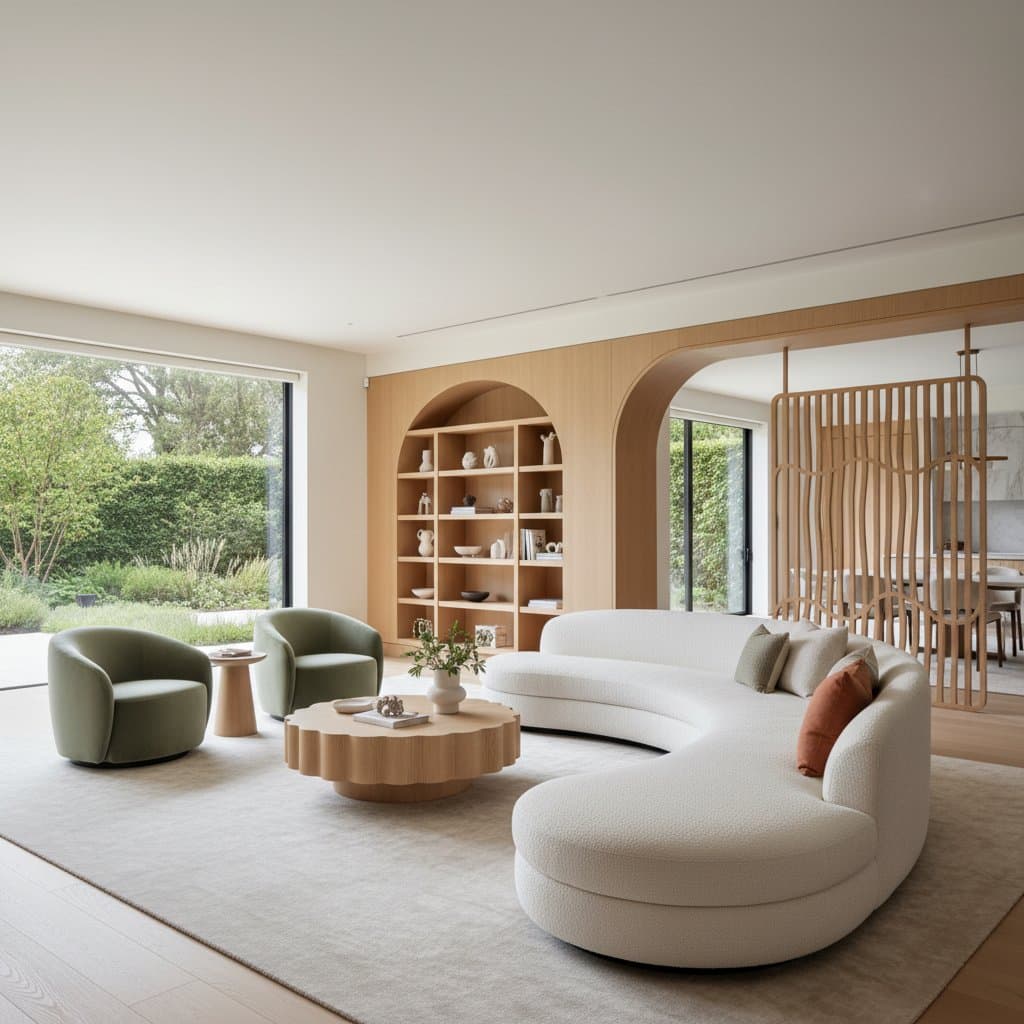
Curved Furniture Trends Shaping 2025 Home Design
Home design evolves periodically, and the current direction favors gentle contours over abrupt edges. Curved furniture transitions from exclusive designer spaces to everyday living areas, dining rooms, and home offices. This emphasis on organic shapes and fluid lines addresses more than aesthetics; it aligns with desires for homes that promote relaxation and connection. As a professional remodeler, observations confirm that curved pieces resolve practical issues in layout and comfort that linear furniture often exacerbates.
Reasons Curved Furniture Aligns with Modern Needs
Homeowners frequently overlook the impact of furniture contours on room ambiance. Straight lines and sharp angles prevail in typical architecture, leading to enclosed, rigid atmospheres when furniture mirrors these traits. Curved elements, such as sofas with rounded arms, oval dining tables, or chairs with softened edges, introduce dynamic movement and encourage interaction by eliminating divisive corners.
In open-concept plans, where walls vanish to expand living areas, furniture defines zones without fragmentation. A curved sectional, for instance, delineates a seating nook from an adjacent kitchen while preserving unobstructed views and spatial continuity. This approach maintains expansiveness yet provides subtle organization.
Psychological Benefits of Curved Forms
Rounded shapes draw people instinctively due to their links to natural elements. Design psychology links curves to sensations of ease, serenity, and security, evoking smooth pebbles, winding paths, or gentle landscapes. Spaces incorporating these forms project warmth and approachability, resonating with contemporary preferences for nurturing environments.
Clients often report heightened relaxation in curved-filled rooms, attributing it subconsciously to the design. Curves dissolve barriers, unlike straight lines that accentuate divisions, thereby fostering a more inclusive experience.
Selecting Materials to Amplify Curved Aesthetics
Pair curved furniture with materials that accentuate its inherent gentleness. Textured upholstery options, including boucle, chenille, or brushed velvet, add dimension through light play and subtle shadows on rounded surfaces. For solid pieces, select wood with visible grain or matte stone to echo natural fluidity; avoid high-gloss treatments, which may impart an impersonal, sci-fi vibe unsuitable for cozy homes.
Consider a recent project where a curved sofa in earthy linen complemented a round oak pedestal table. The interplay of forms and textures unified the area, yielding a harmonious setting unattainable with angular alternatives.
Pitfalls to Avoid When Incorporating Curves
While visually appealing, curved furniture demands strategic integration. A prevalent error involves ignoring scale: shoppers select pieces from images without assessing spatial fit. Curved designs occupy broader footprints, particularly along outer arcs, potentially disrupting pathways if not planned.
Another issue arises from overusing curves, resulting in visual clutter. Limit to focal elements for equilibrium; a single curved console with a rectangular bookcase maintains poise. Overloading with multiple rounds, such as circular tables, arched doorways, and wavy shelves, risks disarray.
Construction Considerations for Curved Elements
Professionals encounter unique hurdles when fabricating curves. Custom curved cabinetry or seating requires exact framing to trace the arc, with materials like plywood layered or steam-bent for precision. Drywall installations involve scoring and flexing sheets to form seamless bends, extending labor time.
For premium renovations, these efforts yield bespoke results. A contoured window seat or rounded countertop imparts artisanal quality beyond standard rectilinear builds. Engage skilled fabricators experienced in curves to ensure flawless execution, as sketches belie the technical demands.
Integrating Curves into Established Interiors
Many prefer gradual updates over full overhauls. Curved accents harmonize with linear pieces through deliberate positioning. Introduce a bowed armchair amid boxy cabinets to temper severity without overwhelming the palette.
Illuminate strategically with curved fixtures, like orb-shaped lamps or arched floor standards, to reinforce the motif. Subtle props, including sinuous sculptures or oval trays, build cohesion without uniformity. Focus on rhythmic balance rather than exact replication.
Cost Implications of Curved Investments
Curved items command premiums due to intricate production. Forming bends necessitates specialized jigs, reinforced structures, and meticulous padding, inflating expenses by 10 to 30 percent over linear counterparts. Custom orders amplify this through tailored engineering.
Quality curved furniture endures trends, retaining value in resale markets. Inferior imitations falter with uneven contours or weak joins, underscoring the merit of reputable sources. Long-term durability offsets initial outlay.
Enduring Advantages of Curved Design
Curves transcend styles, suiting minimalist, retro, or classic schemes. This adaptability stems from a broader pivot toward humane, intuitive spaces. Linear forms impose structure; curves infuse vitality and personalization.
In compact areas, rounded profiles enhance perceived volume by smoothing transitions and easing navigation. A crescent console in a narrow hall, for example, facilitates passage while adding grace, optimizing utility without expansion.
Practical Care for Curved Pieces
Preserve curved furniture through routine upkeep tailored to its form. Upholstered curves highlight dust in recesses; use a soft-bristle tool for gentle cleaning to prevent fiber compression. Stone or wood elements benefit from mild, pH-neutral solutions applied along contours to avoid residue buildup.
For restorations, consult specialists adept at curved geometries. They manage seam tensions and pattern matches that generic services overlook, safeguarding the piece's silhouette and longevity.
Embracing Curves for Enhanced Living
Adopting curved furniture elevates open concepts by blending functionality with serenity. These elements not only resolve spatial tensions but also cultivate environments that nurture well-being. Invest thoughtfully to realize a home that flows intuitively and invites daily comfort.